 sutikshan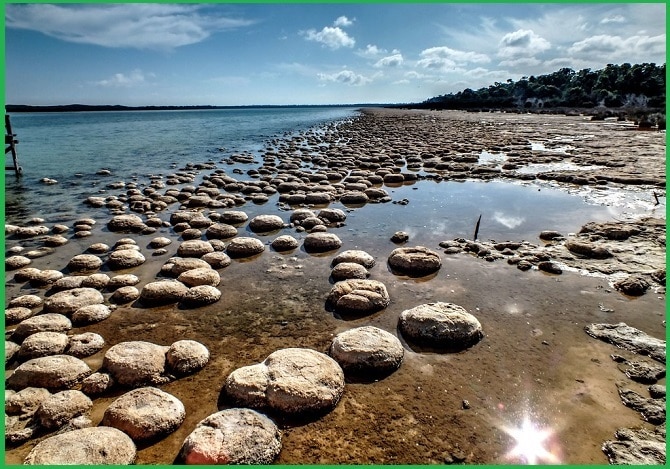
Lake Clifton Thrombolites
Lake Clifton is a small town in the Peel region of Western Australia, located on the east side of the lake of the same name. It is situated just off the Old Coast Road, between Mandurah and Bunbury, and marks the northern boundary of Yalgorup National Park.
Lake Clifton is famous for Thrombolites, A rock-like structure built by tiny microorganisms, which can be seen at the edge of Lake Clifton. These formations, which are similar to stromatolites, are significant because the organisms that create them are believed to resemble the Earth’s earliest life forms.
Situated within Yalgorup National Park, just south of Mandurah, the ancient thrombolite reef at Lake Clifton provides a rare and fascinating glimpse into Earth’s earliest days. These remarkable, rock-like formations are among the planet’s oldest life forms, dating back approximately 570 million years. Their ancient ancestors played a crucial role by producing the oxygen that paved the way for all subsequent life.
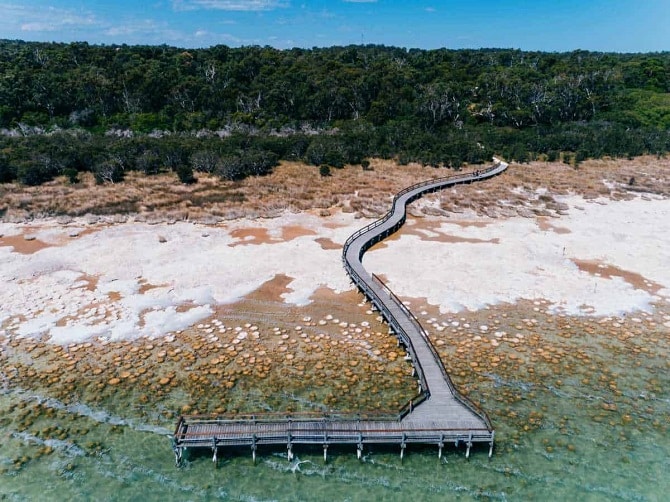
The Lake Clifton thrombolites themselves, around 2,000 years old, form the largest living reef of its kind in the Southern Hemisphere. A boardwalk allows you to observe these formations up close; the best views are typically found between January and May when lower water levels expose them more clearly.
Lake Clifton Thrombolites Car Park
The car park for the Lake Clifton thrombolites is situated at the terminus of Mount John Road in Herron, Western Australia. From here, visitors can take a short, wheelchair-accessible boardwalk directly over the lake to observe the formations up close. The site is easily reached, with the car park being signposted off Highway 1, and basic toilets are available for public use.
Also read- Ningaloo Reef Marine Animals-A Garden of Coral Reef and UNESCO Site
Significance of Thrombolites
The primary significance of thrombolites lies in their link to the dawn of life on Earth.
Living Fossils: The microorganisms that build thrombolites are descendants of some of the earliest life forms to evolve on our planet, approximately 3.5 billion years ago.
Oxygen Producers: These ancient microbial structures (along with stromatolites) were responsible for the Great Oxygenation Event, gradually producing the oxygen that eventually allowed for the evolution of all subsequent complex life.
The Difference from Stromatolites: Thrombolites are a type of microbialite, just like stromatolites. However, thrombolites became more dominant in the fossil record later, as they are thought to be more resilient to the destructive effects of grazing and burrowing animals (metazoans) that evolved around 570 million years ago. The thrombolites currently living in Lake Clifton are much younger—estimated to be around 2,000 years old—but they behave in the same ancient way.
Structure and Composition
Thrombolites (Clotted): The name “thrombolite” comes from the Ancient Greek, meaning “clot stone.” Their defining characteristic is an internally clotted, non-laminated structure. They are composed of millimeter-to-centimeter scale “clots” or lumps of calcified microbes (called thromboids), interspersed with cavities and sediment. Stromatolites (Layered): In contrast, stromatolites have a distinctly layered or laminated structure resulting from the regular, upward-growing microbial mats.
External Structure
The Lake Clifton thrombolites form an extensive, reef-like structure over 6 kilometers long along the eastern shore, making it the largest lake-bound thrombolite reef in the Southern Hemisphere. Individually, they exhibit a variety of external shapes, including:
Conical, Domical (dome-shaped), Discoidal (disc-shaped), Tabular (flat), and Irregular columnar structures, which can grow up to 1.3 meters high.
Also Read- Geotourism And Modern Geotechniques
How To Reach Lake Clifton
To reach the Lake Clifton thrombolites, drive south on Old Coast Road from Mandurah and turn onto Mount John Road. Park at the designated car park on Mount John Road and follow the boardwalk to view the thrombolites, which are also visible from the start of the 5km Lakeside Loop walk.
The primary entry point for Lake Clifton is Perth Airport (PER). Travelers flying in must first reach Perth city, then take a train or bus southbound to Mandurah Station (the nearest major rail hub). From Mandurah, the final leg of the journey to Lake Clifton requires a local bus service or a taxi.