 sutikshan
Natural Geological features
Some natural features are always stuck in our minds, the reason behind it is that this frame has often been seen around us. I would like to tell you several geological features that have eroded and collapsed, whether by storms, fires, or even vandals. Whether you believe it or not, some of the world’s most treasured natural monuments are no longer with us- take a journey to know these features.
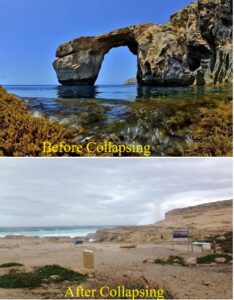
Maltese rock arch, Azure Window
The iconic Maltese rock arch, Azure Window, collapsed into the sea due to heavy storms on March 8, 2017. The popular structure was used as Scenery in several films and TV series, including “Clash of the Titans” in 1981, and “Game of Thrones” in 2011.
Thus, the old man must have been formed after the glacial ice had melted from this area. And Glacial geologists think that the ice was gone from this part of the mountain about 12,000 years ago. Now the filled sand and gravel eroded, and the structure collapsed in 2003.
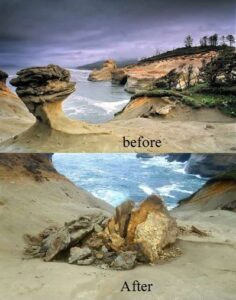
Duckbill – Iconic sandstone formation, known as the “Duckbill,” situated in Oregon, America, and was destroyed by vandals in the year 2016.
The Duckbill was popular among visitors, which is based on Oregon’s northern coast in America. The 10-foot-tall limestone pedestal was an iconic part of the state park. It’s made up of delicate sandstone and is a popular selfie spot along the Oregon coastline. But the rock lost its battle with gravity in August 2016. The rubble serves as a sobering reminder of the ever-present, fragile coastal rocks and cliffs.
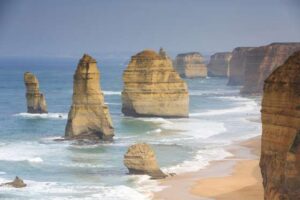
The rock formation “12 Apostles”- along the Great Ocean Road south of Melbourne, Australia, is one of the nine limestone monoliths that fell into the ocean in 2005.
About twenty million years ago, the powerful surf and the salt of the erratic Southern Ocean started to erode the rugged limestone cliffs along the coastline. Action of wind and water carved out cavernous caves in the soft rock.
The Great Ocean Road is home to many spectacular sights in the region, and the 12 Apostles are the jewel in the crown. The road to the 12 Apostles is breathtaking in splendor with its dramatic, rugged cliffs carved from the sea and its panoramic views across the rich and azure waters. The rocky stacks are called the 12 Apostles because they stand tall and proud along the shore. Despite the name of the 12 apostles, there are only 8 left standing in the ocean.
The “Eye of the Needle-“
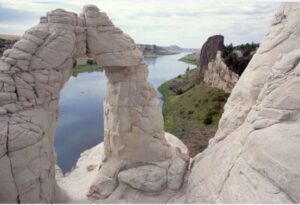
A natural arch on the cliffs above the Upper Missouri River, called “Eye of the Needle,” was destroyed by vandals in 1997. The Eye of the Needle was an 11-foot-3 m-high naturally occurring geographic formation. The shape was much like an inverted “V”. It was located along a section of the Upper Missouri National Wild and Scenic River.
The top 1 m of the arch had fallen, leaving two pillars. Six other columns near the arch on the south side of the river were also toppled. The arch was destroyed by the normal process of erosion and weathering. The sandstone arch called Eye of the Needle, looking at the bluff’s high color, forms a gateway.
“God’s Finger-“
Situated in Spain’s Canary Islands, it was destroyed by Tropical Storm Delta in 2005. God’s Finger is a sea stack about 30 m high in the Atlantic Ocean, located off the northern part of Gran Canaria, one of the Canary Islands of Spain. During the tropical storm Delta in November 2005, “God’s finger”, the thin top of the rocky monument, broke off and fell into the sea.
Geologically, the area is the oldest in Gran Canaria, which started to form around 14 million years ago. Over a period of 200-300,000 years, the oddly shaped monument was created from the basaltic materials in the area. The peculiarly shaped rock has been an inspiration to many artists, and it is believed that the author Domingo Doreste was the first to name it God’s finger.
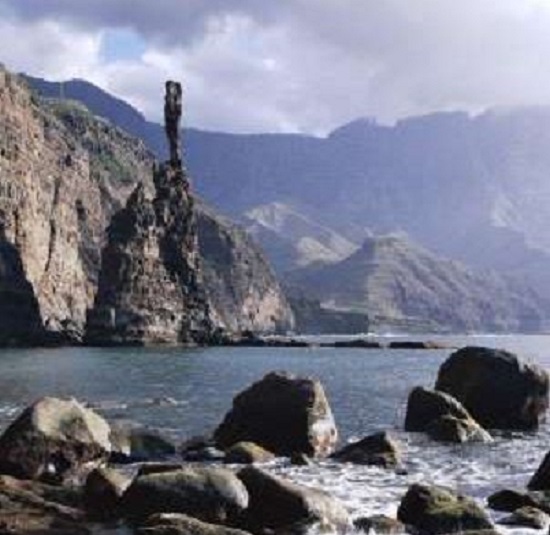
Photo: God Fonger
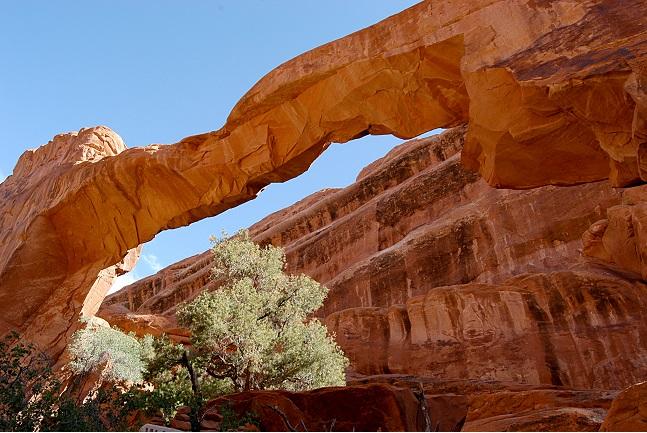
“Wall Arch”- Over 9.14m tall and 21.3 m wide formation, “Wall Arch” in Arches National Park, Utah, collapsed in August 2008. Gravity and erosion got the best of the wall Arch, located along the popular Devils Garden Trail at Arches National Park.
Wall Arch was a free-standing arch in the Slick sandstone rock and had spanned a 71-foot gap in the rock since time immemorial. It was already curving gracefully when the Egyptian pyramids were still under construction. It stood defiantly while the mighty Roman Empire was collapsing an ocean away.
Erosion and gravity reign supreme over sandstone. For countless eons, rain, ice, and groundwater slowly ate away the natural calcium cement holding the arch’s sand grains together, and the whole structure finally came crashing down.
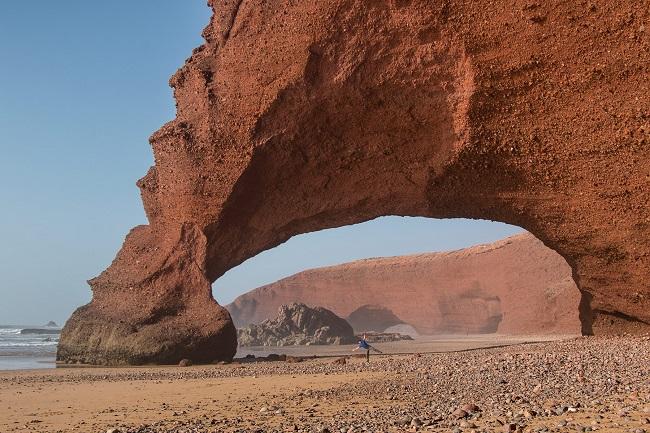
The second, larger arch remains standing further along the beach. The loss of the arch may have an impact on Morocco’s tourism sector. They were among Morocco’s best-known natural wonders: two immense rock archways towering over Legzira beach on the Atlantic coast. They were formed over thousands of years through erosion by the sea.