 sutikshan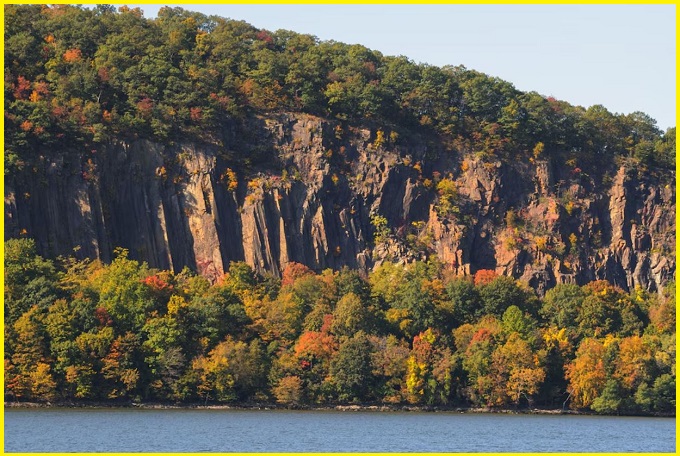
The Palisades Sill
The Palisades Sill is a massive 300 m. thick diabase sheet and a standout feature of the Central Atlantic Magmatic Province (CAMP). Formed approximately 200–201 million years ago during the rifting of Pangea, this Early Jurassic intrusion now lines the Hudson River in New Jersey and New York, where it is best known for its iconic columnar-jointed cliffs. Because of Palisades Sill’s unique geology and accessibility, the site is a major point of interest for rock climbers, geologists, and nature enthusiasts.
Location
Easily seen from western Manhattan, the Palisades Sill is famous for its striking cliffs along the Hudson River. The exposure spans approximately 80 kilometers, beginning in Staten Island and extending into New Jersey. As it follows the river northward, it passes through several cities, including Jersey City, Union City, Fort Lee, and Englewood Cliffs.\
Geology
The end of the Triassic Period was marked by the massive rifting of Pangea, as eastern North America began separating from northwestern Africa to form the Atlantic Ocean. During this process, decompression melting generated magma that intruded into the Stockton Formation’s sandstones and arkoses within the Newark Basin.
Also read- Fort Dodge Gypsum, Gypsum, Iowa: A Hidden Mississippian wonder
Over millions of years, this magma solidified, and subsequent uplift and erosion eventually exposed the Palisades Sill. While composed of diabase, the sill’s mineralogy—consisting primarily of plagioclase feldspar, pyroxenes, and olivine—is not uniform. Research indicates that the body becomes increasingly differentiated, moving away from its upper and lower contacts, meeting at a central “sandwich horizon” where the cooling fronts converged, and differentiation is most pronounced.
The Palisades Sill maintains an average stratigraphic thickness of 300 meters, with its celebrated cliffs rising roughly 100 meters above sea level. For most of its length, the intrusion dips westward at an angle of 10 to 15 degrees. Stratigraphic studies indicate that the sill originally formed at a depth of approximately 3 to 5 kilometers.
Also read- Geotourism And Modern Geotechniques
How to reach Palisades Sill, New Jersey
Stretching 50 miles from Jersey City, New Jersey, to Nyack, New York, the Palisades Sill forms a dramatic cliff line along the Hudson River. These formations are easily reached from New York City and New Jersey via the George Washington Bridge (I-95) or the Palisades Interstate Parkway, with Fort Lee and Nyack Beach State Park serving as primary access points.