 sutikshan
Earth’s Magnetic Field Reversals
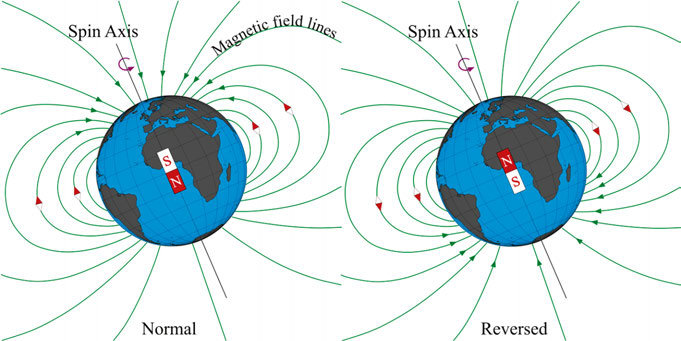
Earth’s magnetic field reverses roughly every 200,000 to 300,000 years, with magnetic north and south swapping places over hundreds or thousands of years. While not currently causing climate change, the weakening field (up to 90% weaker during transitions) can disrupt satellites, power grids, and animal navigation, while potentially increasing surface radiation
Earth’s magnetic field periodically reverses polarity, swapping magnetic north and south, a phenomenon recorded in rocks and sediments and caused by changes in the liquid iron core. These flips occur irregularly, averaging every few hundred thousand years but varying significantly in timing and duration, with the last major reversal approximately 780,000 years ago. While a reversal isn’t imminent, the field is currently shifting, with the North Pole drifting towards Siberia. During a flip, the field weakens and becomes more complex, potentially impacting technology and navigation.
183 Reversals in the past 83 million years
Geomagnetic reversals appear to occur in a statistically random manner. Over the past 83 million years, at least 183 reversals have taken place, averaging roughly one reversal every 450,000 years. The most recent event, the Brunhes–Matuyama reversal, occurred about 780,000 years ago, though estimates of its duration vary widely. Some studies suggest that the four most recent reversals each took approximately 7,000 years to complete.
Clement (2004) proposed that reversal duration depends on latitude, occurring more rapidly at low latitudes and more slowly at mid and high latitudes. Other estimates place the total duration of full reversals between 2,000 and 12,000 years.
There have been instances when Earth’s magnetic field reversed for only a few hundred years, such as during the Laschamp excursion. These short-lived events are classified as geomagnetic excursions rather than full reversals. Even during stable polarity chrons, large and rapid directional excursions are common; they occur more frequently than complete reversals and may represent failed reversal attempts. In such cases, the magnetic field reverses within the liquid outer core but not in the solid inner core. Magnetic diffusion in the outer core occurs over timescales of about 500 years or less, whereas diffusion in the inner core is much slower, taking roughly 3,000 years.
Geomagnetic Polarity Time Scale
By examining magnetic patterns preserved in ocean-floor basalts and correlating them with dated reversal records from continental rocks, paleomagnetists have constructed the Geomagnetic Polarity Time Scale. The present version of this time scale identifies 184 distinct polarity intervals over the past 83 million years, representing 183 magnetic reversals.
History
In the early 20th century, geologists like Bernard Brunhes observed that certain volcanic rocks carried magnetization opposite to the direction of the existing Earth’s magnetic field. Later, in the late 1920s, Motonori Matuyama provided the first systematic evidence and estimated timeline for magnetic reversals, noting that rocks showing reversed polarity dated back to the early Pleistocene or earlier. At that time, Earth’s magnetic polarity was not well understood, and the concept of magnetic reversals attracted little scientific attention.
Three decades later, as understanding of Earth’s magnetic field improved, scientists began proposing that the planet’s magnetic field may have reversed in the distant past. During the late 1950s, much paleomagnetic research focused on studying polar wandering and continental drift. Researchers found that while some rocks could alter their magnetization during cooling, most volcanic rocks retained a record of Earth’s magnetic field from the time they cooled below the Curie temperature. Because reliable techniques for determining the absolute ages of rocks were not yet available, scientists estimated that magnetic reversals occurred roughly once every million years.
Also Read- Asteroid Mining and Its Challenges: Future of Space Resources
Superchron
A superchron is an extended period of stable magnetic polarity lasting at least 10 million years. Two widely recognized examples are the Cretaceous Normal Superchron and the Kiaman Reverse Superchron. A possible third example, the Moyero Superchron, remains debated among scientists. The Jurassic Quiet Zone, once considered evidence of another superchron, is now believed to have resulted from different geological processes.
The Cretaceous Normal Superchron, also known as C34, lasted about 37 million years—from roughly 120 to 83 million years ago—spanning part of the Cretaceous period between the Aptian and Santonian stages. In the time leading up to this interval, magnetic reversals gradually became less frequent, eventually ceasing entirely during the superchron. Since its end, reversal frequency has generally increased slowly toward the present.
The Kiaman Reverse Superchron extended from the late Carboniferous to the late Permian, lasting more than 50 million years (approximately 312 to 262 million years ago). During this time, Earth’s magnetic field maintained a reversed polarity. The term “Kiaman” originates from the town of Kiama in Australia, where some of the earliest geological evidence for this superchron was discovered in 1925.
Magnetic Reversals Transitions
Duration
Most estimates suggest that a geomagnetic polarity transition lasts between 1,000 and 10,000 years, although some research proposes that certain shifts may have occurred within the span of a human lifetime. During a reversal, the magnetic field does not disappear entirely; instead, it weakens and may produce multiple unstable poles scattered across the globe before eventually stabilizing again.
Research on 16.7-million-year-old lava flows from Steens Mountain indicates that Earth’s magnetic field may have changed direction at rates of up to 6 degrees per day. Initially, many paleomagnetists questioned these findings. It was argued that even if rapid changes occurred within the core, the mantle—acting as a semiconductor—would smooth out fluctuations lasting less than a few months. Several rock-magnetic processes were also suggested as possible explanations for misleading signals. However, later paleomagnetic studies of the Oregon Plateau flood basalts produced consistent results.
Evidence suggests that the reversed-to-normal transition marking the end of Chron C5Cr (about 16.7 million years ago) involved multiple rapid reversals and excursions. Further support comes from studies by Scott Bogue of Occidental College and Jonathan Glen of the United States Geological Survey, who examined lava flows in Battle Mountain. Their findings indicate a short reversal episode lasting only a few years, during which the magnetic field direction shifted by more than 50 degrees, around 15 million years ago.
More recently, research published in 2018 suggested that one reversal may have lasted only about 200 years. In contrast, a 2019 study estimated that the most recent major reversal—the Brunhes–Matuyama reversal, approximately 780,000 years ago—took around 22,000 years to complete.
Causes
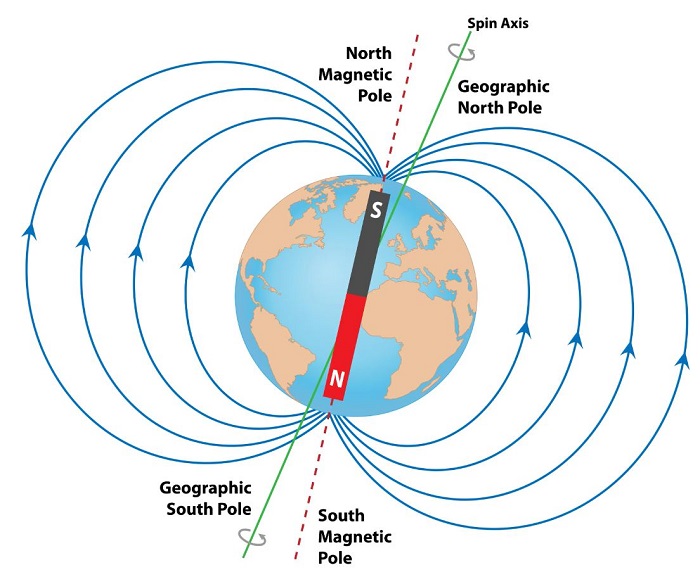
Earth’s magnetic field—like those of other magnetized planets—is produced by dynamo action within the core. The convection of molten iron generates electric currents, which in turn create magnetic fields. In computer simulations of planetary dynamos, polarity reversals often arise naturally from the system’s internal dynamics.
For instance, Gary Glatzmaier and Paul Roberts at the University of California, Los Angeles developed a numerical model that coupled electromagnetism with fluid motion inside Earth. Their simulation successfully reproduced major characteristics of the geomagnetic field over more than 40,000 years of simulated time, and the modeled field even reversed polarity on its own.
Irregular global magnetic reversals have also been replicated experimentally in laboratory liquid-metal setups, such as the VKS2 experiment, further supporting the dynamo-based explanation for geomagnetic reversals.