 sutikshan
Asteroid Mining
Asteroid mining faces significant geological and environmental challenges due to near-zero gravity and the absence of planetary differentiation, resulting in dispersed resources rather than concentrated ore bodies. Major difficulties include unstable, dust-covered surfaces, the need for costly specialized drilling systems, and extreme temperature variations.
Asteroid mining refers to the theoretical process of extracting valuable materials from asteroids and other small planetary bodies, including near-Earth objects.
Why is Asteroid Mining?
With Earth’s resources under increasing pressure, asteroid mining is gaining interest as a potential source of valuable elements, whether for commercial return to Earth or for supporting space infrastructure like solar power satellites and space habitats. Hypothetically, ice-derived water could be converted into fuel for orbiting propellant depots.
Asteroids are classified into several types, with the three primary categories being C-type, S-type, and M-type asteroids.
C-type asteroids are rich in water, which currently has limited direct mining value but could be highly useful for deep-space exploration. Utilizing asteroid-derived water could significantly reduce mission costs by supporting life-support systems and producing fuel. These asteroids also contain abundant organic carbon, phosphorus, and other essential nutrients that could potentially be used for fertilizer and food production.
S-type asteroids contain relatively little water but are considered more attractive for resource extraction due to their high metal content. They include metals such as nickel and cobalt, as well as valuable precious metals like gold, platinum, and rhodium. For example, a small S-type asteroid approximately 10 meters in diameter may contain around 650,000 kilograms of metal, including roughly 50 kilograms of rare metals such as platinum and gold.

M-type asteroids are less common but are exceptionally metal-rich, often containing up to ten times more metal than S-type asteroids.
Mining Considerations in Asteroid
Several approaches have been proposed for asteroid mining, broadly categorized into four main strategies:
-
In-space manufacturing (ISM):
Resources are processed and utilized directly in space, potentially supported by emerging techniques such as biomining. -
Transporting raw material to Earth:
Asteroidal material is extracted and returned to Earth for processing and use. -
On-site processing with selective return:
Materials are processed at the asteroid, with only refined products transported back to Earth. This approach may also enable the production of propellant for the return journey. -
Relocating the asteroid:
The asteroid could be moved into a stable orbit around the Moon, Earth, or a space station, theoretically allowing for more complete resource utilization with minimal waste.
Also Read- Earthquake Early Warning Systems: Role of Artificial intelligence and IoT
Processing materials in situ to extract high-value resources can significantly reduce the energy required for transportation. However, the necessary processing infrastructure must first be delivered to the mining site. In-situ mining techniques may involve drilling boreholes and injecting heated fluids or gases to melt or chemically react with target materials, enabling their extraction. Due to the extremely weak gravity of asteroids, such operations can generate substantial disturbances and dust clouds. These effects may require containment systems—such as domes or bubble-like barriers—or rapid dust mitigation methods to ensure safe and efficient operations.
Space-based mining operations demand highly specialized equipment designed to extract and process ore under microgravity conditions. Mining systems must be firmly anchored to the asteroid to remain stable, though once secured, the low-gravity environment allows materials to be moved more easily. Despite this advantage, reliable techniques for refining ore in zero-gravity conditions have yet to be developed.
One proposed method for docking involves a harpoon-style anchoring mechanism, in which a projectile embeds itself into the asteroid’s surface to provide a stable attachment point. A connected cable or tether could then draw the spacecraft toward the asteroid, assuming the surface is sufficiently solid and penetrable to support effective anchoring.
Challenges in Space Mining
Geological and Operational Challenges
Lack of Research
To date, approximately 127 grams of asteroid material have been successfully brought to Earth by various mission like-Hayabusa, Hayabusa2, OSIRIS-REx, and Tianwen-2. Asteroid sample-return missions are highly complex and have yielded only small quantities of material: less than 100 milligrams from Hayabusa, 5.4 grams from Hayabusa2, and about 121.6 grams from OSIRIS-REx, with China’s Tianwen-2 mission currently in progress. These sample amounts are relatively minor when weighed against the significant financial and technological investments Purose.
Microgravity Constraints
The extremely low gravity environment complicates conventional drilling operations, as reaction forces can push mining equipment away from the surface. Excavated material may drift into space, forming debris clouds that pose serious risks to nearby instruments and spacecraft.
Uncertain Subsurface Structure
Many asteroids are believed to be loosely bound “rubble piles” with poorly understood internal compositions. This uncertainty makes it difficult to predict whether drilling will encounter solid rock, ice deposits, or unconsolidated debris.
Harsh Environmental Conditions and Thermal Cycling
Asteroids undergo extreme temperature fluctuations, and the absence of an atmosphere exposes mining systems to intense radiation and severe heat–cold cycles, demanding highly durable and resilient equipment.
Material Handling Challenges
Managing fine, adhesive dust and extracting volatile resources such as water ice in a vacuum requires advanced and largely unproven technologies. Innovative methods such as Optical Mining™, which vaporizes material rather than mechanically excavating it, may be necessary.
Impact on Resource Extraction
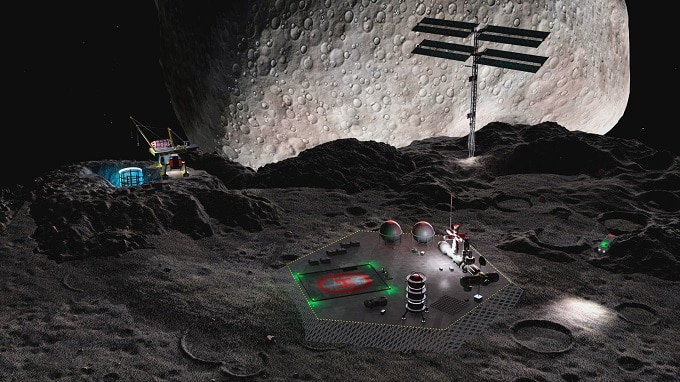
Due to the lack of natural mineral concentration, even metal-rich asteroids may be economically unviable to mine. The energy demands and infrastructure requirements can outweigh potential returns, making success dependent on highly efficient, autonomous, and high-throughput extraction systems.
Asteroid mining offers immense promise, but major geological challenges—including uncertain composition, microgravity constraints, complex regolith behavior, and structural instability—remain significant barriers. Overcoming these hurdles will require major advances in space geology, robotics, and materials science.
The Outer Space Treaty
After nearly ten years of negotiations among almost 100 nations, the Outer Space Treaty was opened for signature on 27 January 1966 and came into force on 10 October 1967, establishing the fundamental legal framework governing activities in outer space. The treaty achieved widespread international acceptance, with ninety-six countries ratifying it and an additional twenty-seven states signing.
Consequently, international space law is founded on five principal space treaties, supported by various resolutions and declarations. Foremost among these is the 1967 Outer Space Treaty, commonly described as the “Constitution of outer space.” Through ratification, ninety-eight nations affirmed that outer space is the “province of all humankind,” that all states have the freedom to explore and use it, and that such activities must be carried out for the benefit of all humanity.
Countries and Asteroid Mining Initiative
Luxembourg
In February 2016, the Government of Luxembourg announced plans to stimulate the development of an asteroid-mining industry, aiming to establish a supportive legal framework and regulatory incentives for companies operating in the sector. By June 2016, the government further committed to the initiative by pledging more than US$200 million for research, technology demonstrations, and direct equity investments in space-resource companies relocating to Luxembourg.
Also Read- Geotourism And Modern Geotechniques
In 2017, Luxembourg became the first European nation to enact legislation granting companies ownership rights over resources they extract from space. The country continued to play a leading role in shaping space resource policy and promoting international discussion on space mining throughout 2018.
United States
Several countries have begun establishing legal frameworks to govern the extraction of extraterrestrial resources. In the United States, the Space Resource Exploration and Utilization provisions of the SPACE Act of 2015 were designed to promote private-sector development of space resources while remaining consistent with U.S. obligations under international treaties. The legislation was passed by the U.S. House of Representatives in July 2015 and the U.S. Senate in November 2015.
On 25 November 2015, President Barack Obama signed H.R. 2262, formally known as the U.S. Commercial Space Launch Competitiveness Act, into law. The act recognizes the right of U.S. citizens to own resources they extract from space and encourages the commercial exploration and utilization of asteroid resources. These rights are specifically outlined in Section 51303 of the legislation.