sutikshan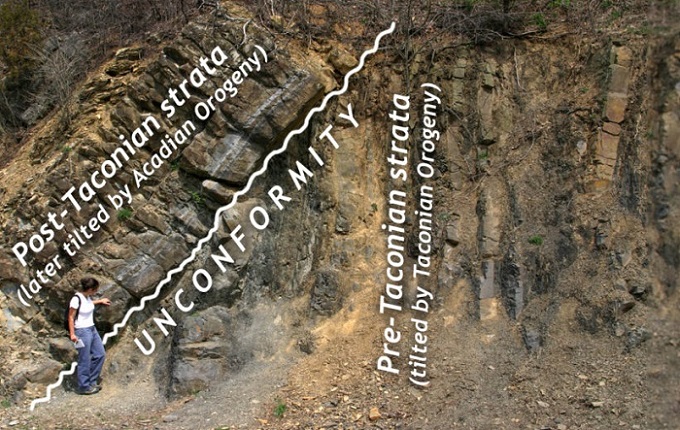
Taconic Unconformity, New York
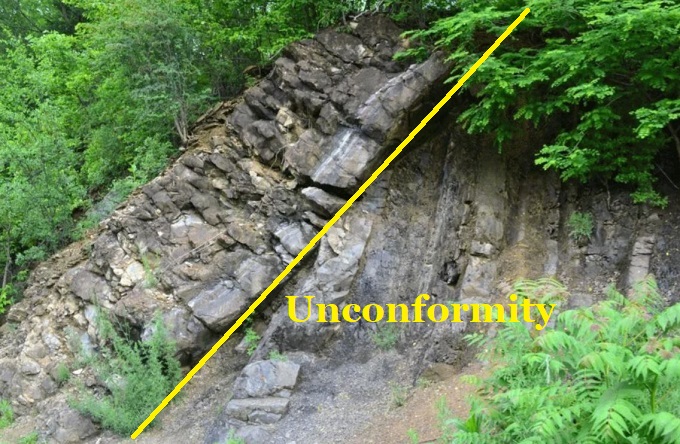
The Taconic Unconformity in New York is a well-known and clearly visible angular unconformity that marks a significant geological hiatus formed during the Ordovician-age Taconic Orogeny. It features younger Silurian strata, such as the Rondout Formation, resting atop older Ordovician rocks like the Austin Glen Formation, which are steeply tilted or nearly vertical—evidence of intense mountain-building, deformation, and subsequent erosion.
During the late Ordovician, subduction drove a volcanic island arc into collision with ancestral North America (Laurentia), forming an extensive mountain belt and generating vast amounts of eroded sediment. Today, geoscientists study the resulting sedimentary deposits, along with the metamorphic and igneous rocks formed deep within the mountain roots, to understand this mountain-building event known as the Taconic (or Taconian) Orogeny.
The Taconian Orogeny was the earliest of three major mountain-building events along the eastern margin of North America during the Paleozoic Era. It was followed roughly 100 million years later by the Acadian Orogeny, and ultimately by the Alleghanian Orogeny near the end of the Paleozoic, which completed the assembly of the supercontinent Pangaea.
Angular unconformity
The Taconic Unconformity is an angular unconformity between the vertical beds of the Ordovician Austin Glen Fm. And the overlying, but steeply dipping, Late Silurian Rondout Fm.
An angular unconformity is a geological feature in which younger, nearly horizontal sedimentary layers are deposited atop older rocks that have been tilted or folded. It marks a major gap in geologic time, representing periods of deformation, uplift, and erosion, and indicates a missing portion of the Earth’s geological record.
Tectonic Events
The Taconian Orogeny was triggered by a collision between two tectonic plates: the continental margin of ancestral North America and an oceanic plate that has since disappeared. This oceanic plate was part of the Iapetus Ocean floor. As it converged with North America, oceanic lithosphere associated with the continental margin was subducted beneath the overriding oceanic plate, leading to the formation of a volcanic island arc in the Iapetus Ocean.
Thus, the orogeny involved processes occurring both along the ancestral North American margin and within the offshore volcanic arc. Rocks formed in this island arc were gradually transported toward North America and eventually accreted onto the continent during the collision. Isotopic dating records this dual history, showing an initial phase of crystallization within the arc followed by later metamorphism during the orogeny. The Port Deposit Tonalite, a metamorphosed granitoid, is a good example: before the Taconian Orogeny, it existed simply as a granitoid body beneath a volcanic system, slowly moving toward the Laurentian continental slope at a rate of a few centimeters per year.
Before the onset of the orogeny, the margin of ancestral North America was a passive continental margin, marking the edge of the continent rather than an active plate boundary. Throughout the Cambrian and much of the Ordovician, the region remained tectonically quiet, with little to no activity for long periods. Covered by a shallow epicontinental sea, it hosted the deposition of limestone and dolostone in a carbonate bank environment similar to the modern Bahamas. Sedimentary features such as ooids and stromatolites indicate shallow marine conditions, while the low presence of clastic materials like clay and silt reflects minimal terrestrial input. Fossil-rich limestones containing brachiopods, bryozoans, and other Paleozoic filter feeders further suggest clear, sediment-free waters with little runoff.
Also Read- The World’s most Wilderness Coastline- Kimberley Australia
Taconic orogeny
The Taconic Orogeny was a major mountain-building event that concluded around 440 million years ago and impacted much of present-day New England. It produced an extensive mountain chain stretching from eastern Canada through the region now known as the Piedmont along the eastern United States. As these mountains eroded during the Silurian and Devonian periods, their sediments were widely distributed across the modern Appalachian region and into the midcontinent of North America.
Also Read- Geotourism And Modern Geotechniques
How to Reach Taconic Unconformity, New York
The main Taconic Unconformity exposure is located at a roadcut along Route 23A near Catskill, New York, where the vertical Ordovician Austin Glen Formation meets the dipping Late Silurian Rondout Formation. It can be accessed via the Leeds/Jefferson Heights ramp off Route 23/23A, specifically along the off-ramp from Route 23 toward 23B.